
CEEM Seminar | Austin Downey | USC

Edge Intelligence for Structural Health Monitoring: Algorithms, Hardware, and Timing-Aware Co-Design
Structural health monitoring is increasingly constrained not only by sensing capability, but by the ability to turn measurements into reliable state estimates where they are acquired. This seminar presents an edge-intelligence approach to structural health monitoring in which sensing algorithms, computational hardware, and timing requirements are designed together under size, weight, and power (SWaP) constraints. Rather than treating edge deployment as a final implementation step, the work treats hardware, algorithms, sensing, and timing as a coupled design problem. Three examples illustrate this approach. First, LSTM-based signal conditioning executes on microcontrollers embedded in UAV-deployed sensor packages, improving the quality and usability of measurements collected from difficult-to-access structures. Second, physics-based model updating uses finite-element model prediction on microprocessors to provide interpretable, model-informed estimates of structural response. Third, multi-layer perceptrons (MLPs) are deployed on FPGA hardware to enable ultra-high-rate state estimation during shock events, where an estimate must be produced within a rigid and exceptionally short time window. Together, these examples span microcontrollers, microprocessors, and FPGAs, demonstrating how edge-ready structural health monitoring can pair the appropriate algorithmic complexity with the computational resources and timing requirements of the application.
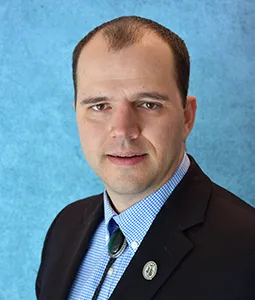
Austin R.J. Downey
Austin R.J. Downey is an Associate Professor in Mechanical, Aerospace, and Civil Engineering at the University of South Carolina and directs the Autonomous Real-Time Systems Laboratory (ARTS-Lab). His research integrates intelligent sensing, real-time model updating, embedded computing, and adaptive systems to develop deployable technologies for structural health monitoring and other physical systems. He has published more than 150 scholarly works and holds two U.S. patents. Dr. Downey is a Fulbright Scholar and recipient of the AFOSR Young Investigator Program award, the NSF CAREER award, and the 2024 South Carolina Governor's Young Scientist Award for Excellence in Scientific Research. His work spans structural health monitoring, robotics, additive manufacturing, energy systems, and battery technologies, unified by the development of real-time algorithms for embedded platforms.