
CIEE E4116: Energy Harvesting
Explore how to harness energy from the environment and transform it into practical power solutions through cutting-edge theory, design, and real-world applications.
Course Overview
This course provides a foundational understanding for conducting multidisciplinary research in energy harvesting, including solar, wind, thermal gradients, vibrations, and ocean waves on both small and large energy scales. Emphasizing both theoretical and practical aspects, the course explores criteria for energy harvesting and the identification of viable ambient energy sources. Topics include the theory of vibrations in discrete and continuous systems, random vibrations, and techniques for vibration measurement and analysis. You will study motion mechanism design and the selection of materials suitable for energy conversion, such as piezoelectric, electromagnetic, thermoelectric, and photovoltaic materials. The course also covers the design, modeling, fabrication, and characterization of harvesters that capture energy from motion, vibration, wind, waves, heat, and light, with attention to resonance phenomena. Additionally, you will examine the role of power electronics in energy storage and management. Case studies will highlight applications in industrial systems, structural monitoring, automotive technologies, and wearable or implantable devices for the human body. This course is intended for senior undergraduate and graduate students with a background in engineering, physics, or a related field.
Course Instructor
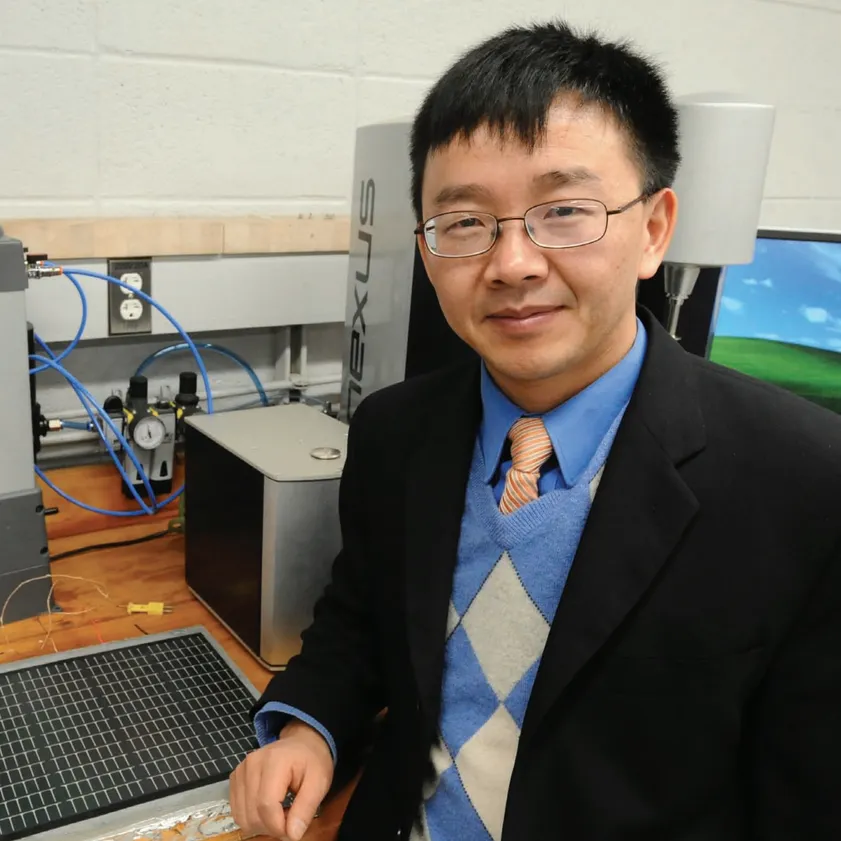
Huiming Yin
Associate Professor of Civil Engineering and Engineering Mechanics
Huiming Yin received his BS in Engineering Mechanics from the Hohai University, China (1995), his MS in Solid Mechanics from the Peking University, China (1998), and his PhD degree in Structures, Mechanics and Materials from The University of lowa (2004).
Yin joined Columbia University as an assistant professor in 2008, before being promoted to associate professor in 2013. His pioneering research, which focuses on energy harvesting in civil infrastructure, has positioned him as a leader in the field of mechanics of modern structures and materials. In 2010, he received the National Science Foundation CAREER Award. Yin has also established the Sustainable Engineering and Materials Laboratory and the Center for Energy Harvesting Materials and Systems (CEHMS), which is supported by NSF Industry/University Cooperative Research Center (IUCRC).
Before joining Columbia, Yin worked for California Department of Transportation (Caltrans) as a Civil Engineer and the University of Illinois at Urbana-Champaign (UIUC) as a Postdoctoral Research Scientist. He has been a registered professional engineer (PE) of Civil Engineering in the states of California and New York. His research team has developed new methods and theories to characterize, simulate and characterize multi-physical behavior of advanced infrastructural materials.