
CIEN E4253: Computational Solid Mechanics with AI
Learn how to use computational machine learning to simulate and predict complex behaviors of solids in engineering and virtual worlds.
Course Overview
Realistic physical simulations of solid materials have a wide range of applications, from designing dams and earth structures, predicting failures of structural components in vehicles and building collapses, to physical modeling for computer animation, computer graphics, and virtual and augmented realities. A fundamental building block of computer simulations is the material models or constitutive laws, which predict the relationships among strain history, microstructure evolution, and stress responses.
This course focuses on the most recent trends in the art of constitutive models for a variety of natural (e.g., sand, clay, rock) and manufactured materials (e.g., rubber, concrete, alloys) in modern engineering applications. This course will cover theories, computational models, and machine learning skills necessary for forecasting elastic and path-dependent material behaviors of solids.
The course is structured around three types of lectures —Theory (T), Computation (C), and Machine Learning (ML). Delivered in subsequent order, each lecture covers three core topics — elastic materials with hyper-elasticity functionals, plasticity theory for solids, and selected advanced topics in data-driven mechanics. Advanced topics may include lie group interpolation, manifold learning, graph embedding, neural network inverse problems, designs of experiments, physics informed neural network, nonconvex optimization and model-free solvers.
You must have a firm grasp of linear algebra, differential equations, calculus and mechanics of solids to undertake this course.
Course Instructor
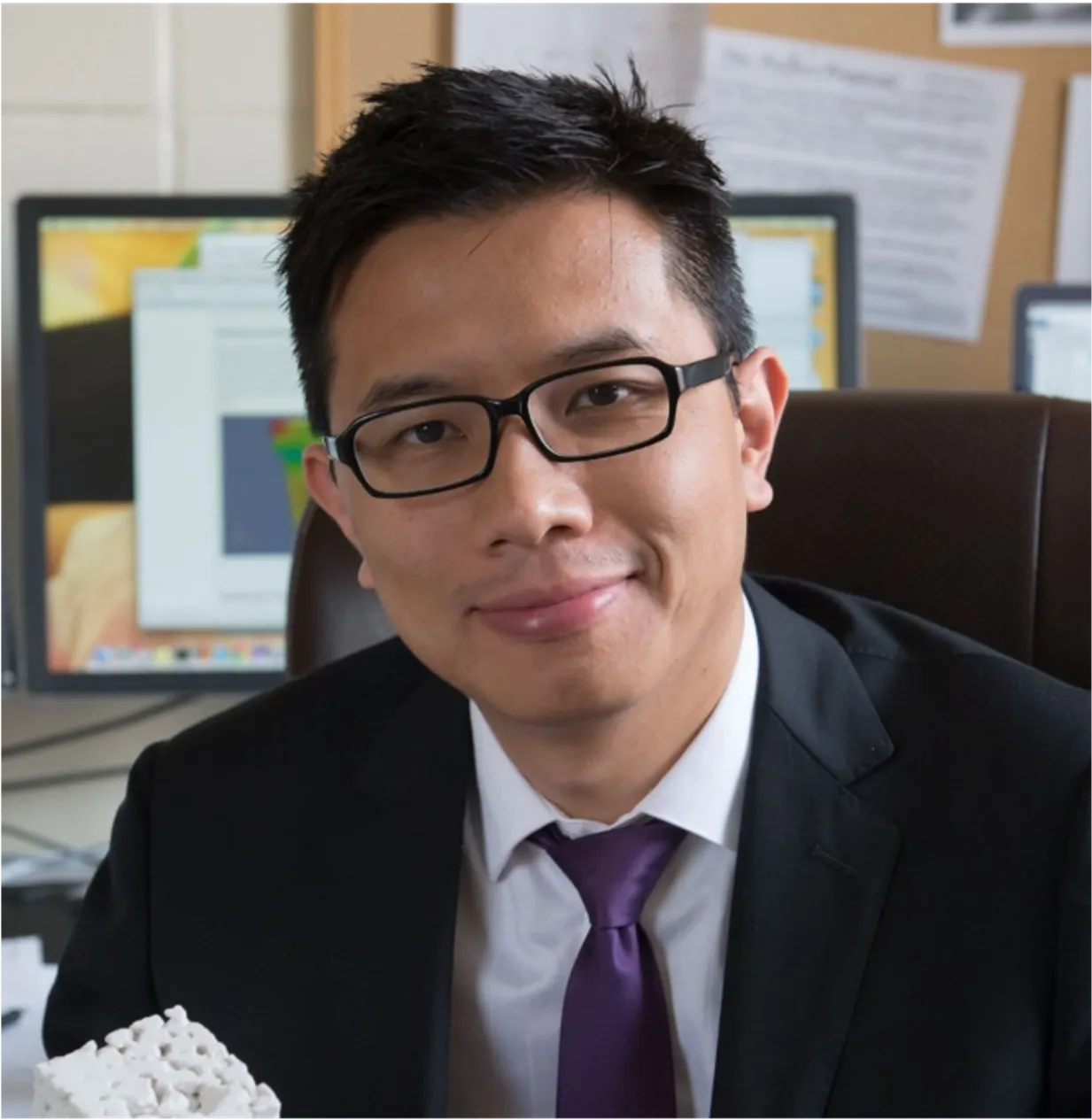
Steve Sun
Associate Professor
Sun is an Associate Professor of Civil Engineering and Engineering Mechanics at Columbia University, focusing on integrating machine learning with solid mechanics. His research focuses on developing interpretable, physics-informed models that enhance the predictive capabilities of computational mechanics, particularly for materials with complex behaviors such as anisotropy, plasticity, and fracture. Sun received the IACM John Argyris Award for his contribution to applications of machine learning for solid mechanics.