
ENME E6220: Stochastic Engineering Mechanics
Explore cutting-edge methods to model, analyze, and quantify uncertainty in complex engineering systems across scales—from nano-devices to critical infrastructure.
Course Overview
This course explores the challenges and methodologies involved in uncertainty quantification within engineering mechanics, focusing on the response and reliability of complex systems under stochastic influences. As modern technology advances in computational power, sensing capabilities, and experimental methods, modeling structural systems across nano- to macro-scales has become increasingly sophisticated. Key challenges include uncertainties in environmental inputs and material properties, as well as system complexity and high dimensionality.
Representative applications range from nano-mechanical resonators—used for chemical and biological detection and affected by thermal noise and nonlinear dynamics—to large-scale infrastructure systems like bridges and nuclear power plants, which are subjected to time-varying stochastic excitations such as earthquakes and wind. These systems are often modeled by high-dimensional, nonlinear stochastic differential equations, whose solutions are crucial for robust design but computationally demanding.
The course covers core topics including random variable and stochastic process theory, modeling and simulating uncertainties in loading and material properties, joint time-frequency analysis, and compressive sensing. Emphasis is placed on advanced solution methods for the engineering system stochastic equations of motion such as Monte Carlo simulation, statistical linearization, and Wiener path integrals. Applications are drawn from civil, marine, mechanical, and aerospace engineering, with a focus on systems exhibiting nonlinear and/or hysteretic behavior.
Course Instructor
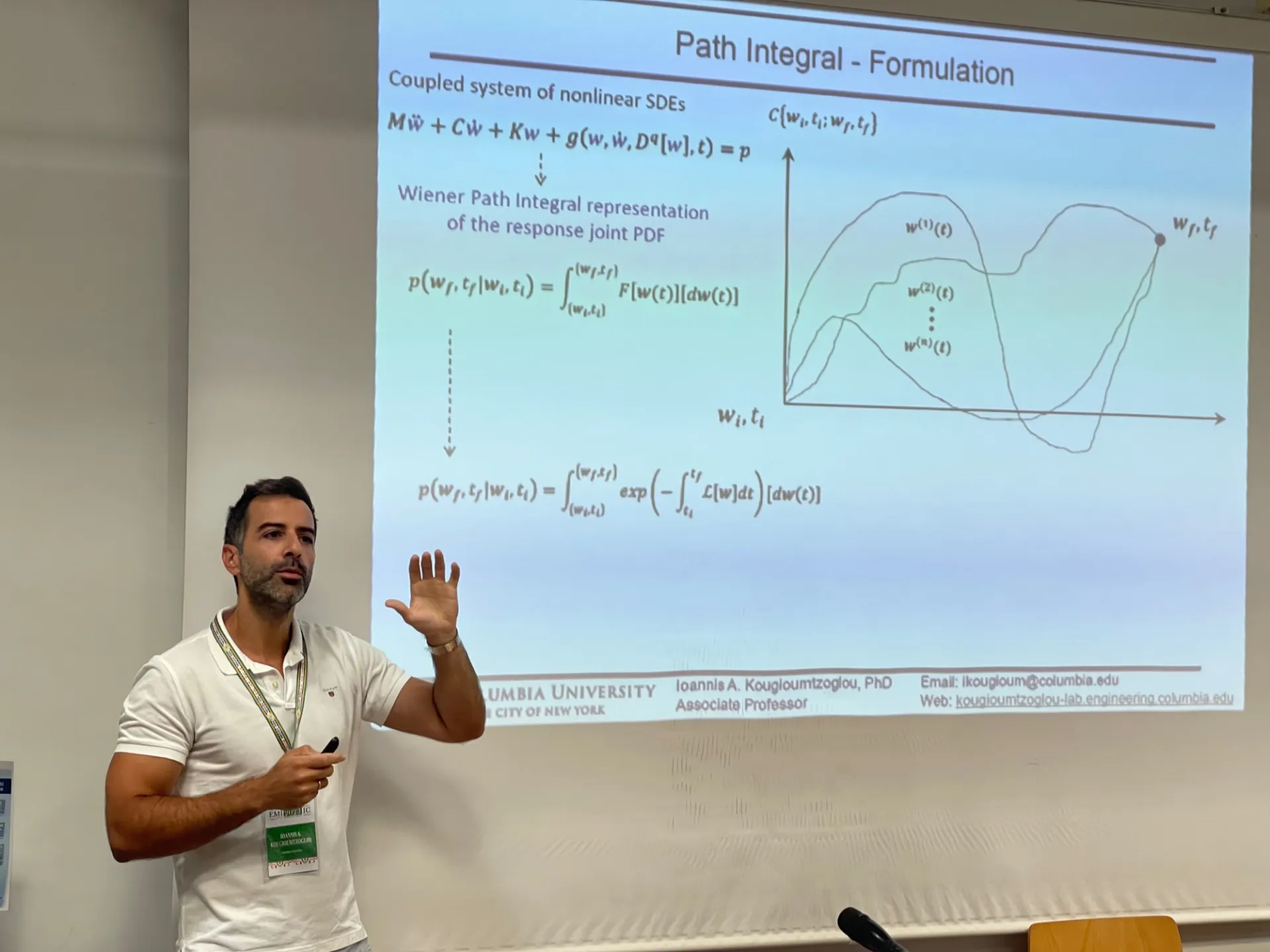
Ioannis A. Kougioumtzoglou
Associate Professor of Civil Engineering and Engineering Mechanics
Kougioumtzoglou and his research group focus on developing analytic and numerical methodologies for stochastic response analysis, reliability assessment, and optimization of complex systems and structures in the presence of uncertainties. These methodologies support the efficient design of dynamic systems at both nano- and macro-scales, such as nano-mechanical oscillators, energy harvesters, and civil infrastructure.
Kougioumtzoglou received his Diploma in Civil Engineering from the National Technical University of Athens (2007), and his MSc (2009) and PhD (2011) from Rice University, USA. He joined Columbia University in 2014 and is currently a tenured Associate Professor in the Department of Civil Engineering and Engineering Mechanics. He has received several prestigious honors, including the Junior Research Prize from the European Association of Structural Dynamics (EASD), the Early Achievement Research Award from the International Association for Structural Safety and Reliability (IASSAR), the Walter L. Huber Civil Engineering Research Prize from the American Society of Civil Engineers (ASCE), and the National Science Foundation (NSF) CAREER award. He is also a Licensed Professional Civil Engineer in Greece and a Fellow of the Higher Education Academy (FHEA) in the UK.