
CEEM Seminar | Oren Lavan | Technion

Optimal design of complex and advanced structural systems subjected to dynamic loadings
Structural systems are often subjected to dynamic loadings. In many cases, these loadings are beyond the serviceability limit state of these systems, hence their behavior under these loads may be complex. This is due to additional physical phenomena that come into play (e.g. material and geometric nonlinearities). To mitigate the effects of these extreme loadings, advanced structural systems, whose behavior itself is also complex, are often developed and used. While these advanced structural systems present a huge step forward, the design process becomes increasingly complex. Furthermore, as there is no intuition as to the effect of such systems on the overall behavior of the structure, their efficient utilization and design present a serious obstacle. Thus, optimization may be very beneficial in such cases.
The analysis of complex and advanced structural systems, when subjected to dynamic loadings, is often a computationally expensive task. This presents an obstacle for its optimization, as multiple function evaluations (or nonlinear structural analyses in time) are required. Thus, gradient-based methods may be advantageous. Nevertheless, as the structural behavior is complex, corresponding realistic optimization problems are expected to be non-convex. This may be more pronounced when the stiffness or the mass of such systems is also to be optimized. In such cases, the natural periods of the system change with the optimization. As the structures are subjected to dynamic loadings, this may often lead to highly non-smooth, or "noisy" optimization problems. These further enhance the challenges of optimizing such systems using computationally efficient gradient-based methods.
The talk will focus exactly on these points while presenting efforts done to overcome the obstacles mentioned above.
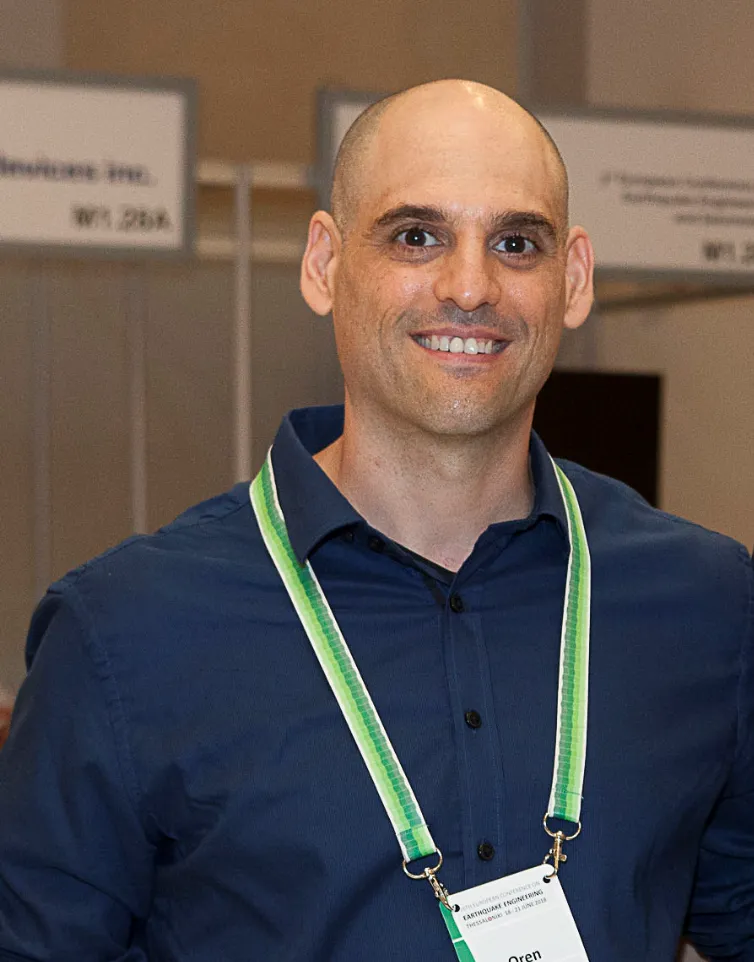
Professor Oren Lavan
Faculty of Civil and Environmental Engineering, Technion