
CEEM Seminar Series | John W. Rudnicki | Northwestern University
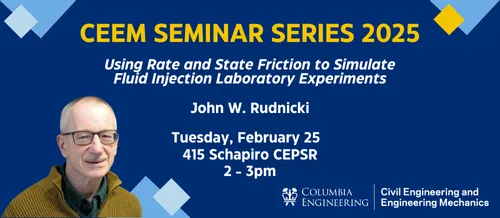
Using Rate and State Friction to Simulate Fluid Injection Laboratory Experiments
Fluid injection into the Earth’s crust for industrial applications, such as disposal of waste water from hydraulic fracturing, extraction of geothermal energy, and carbon sequestration, has caused seismic activity. The seismicity has raised concerns about safety and resulted in limiting or terminating the injection activities. A field experiment in the 1970s that demonstrated fluid injection could cause earthquakes helped to advanced our understanding of this basic mechanism. Nevertheless, there is still much that is not understood about the factors that give rise to induced seismicity. These include the amount and protocols of injection, and the hydrological and material behavior of the faults. Ultimately, field experiments are required in order to address these issues, but their interpretation is often complicated by uncertainties relating to hydraulic and mechanical structure, boundary conditions and stress state. Despite their limited size and time scales, laboratory experiments offer a more controlled environment to explore the interaction of material behavior and injection. This talk will present results for using rate and state friction to model three sets of laboratory experiments with fluid injection. This includes experiments in a double direct shear apparatus under creep conditions on simulated calcite fault gouge (Scuderi et al., EPSL, 2017), experiments on a shale (Scuderi and Collettini, JGR, 2018), and fluid pressure oscillations on granite in a triaxial apparatus (Noȅl et al., JGR, 2019). The comparison of the simulation results and the laboratory measurements shows that rate and friction does capture salient aspects of the experiment but there are clearly other factors that are not well understood. The simulations can explore a wider range of conditions, thereby revealing a richer behavior than is evident from the experiments.
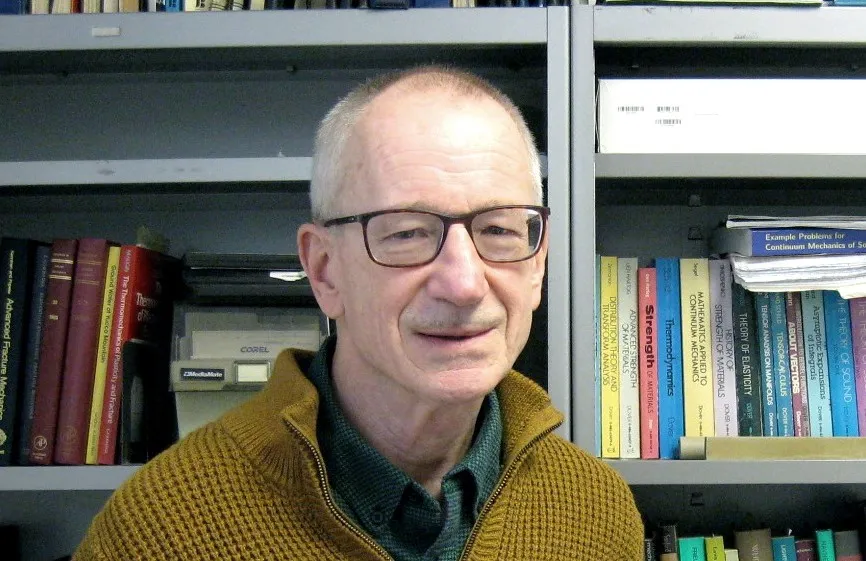
John W. Rudnicki
John W. Rudnicki is Professor of Civil and Environmental Engineering and Mechanical Engineering at Northwestern University where he has been on the faculty since 1981. He earned his Bachelor’s (1973), Master’s (1974) and PhD (1977) degrees in engineering at Brown University. He was a postdoctoral fellow in geophysics at Caltech (1977-1978) and was on the faculty at the University of Illinois at Urbana-Champaign from 1978 to 1981. His research has been in the general area of inelastic behavior and failure of geomaterials. He has been especially interested in the development of localized deformation and in the effects of coupling between deformation and diffusion of fluid and heat in connection with applications to the mechanics of earthquakes, energy storage and recovery, and geological sequestration of CO2. He has held visiting appointments at the École Normale Supérieure (Paris) and as MTS Visiting Professor in the Department of Civil, Environmental, and Geo-Engineering at the University of Minnesota. He has received the Biot Medal (ASCE), Drucker Medal (ASME) and the Brown Engineering Alumni Medal and is a Fellow of the ASME, the Engineering Mechanics Institute (ASCE) and ARMA (American Rock Mechanics Association). He has held a variety of editorial and committee assignments, including Chairman of the Geosciences Council for the Dept. of Energy Basic Energy Sciences, a member of the Advisory Council of the Southern California Earthquake Center, and is currently a member of Editorial Advisory Board of the International Journal for Numerical and Analytical Methods in Geomechanics. He taught a popular undergraduate course on the Mechanics of Sports, has been the McCormick Engineering and Applied Science advisor of the year and on the Honor Roll for Faculty and Administrators, Associated Student Government.